Milan has a reputation for being expensive, and a single tower-climb at the Duomo plus dinner near the Galleria can vaporize €80 before you’ve done anything memorable. Here’s the part most guides bury: a huge slice of the city is genuinely free, and not in a consolation-prize way. I’ve lived here long enough to put together a working list of free things Milan rewards you with — actual frescoed churches, civic museums with permanent collections you’d pay €15 for in Rome, parks the locals defend like backyards, and one Sunday a month when the heaviest hitters open their doors at no charge. This guide walks through every category, with addresses, opening hours, and the small reservation rules that trip up first-timers.
If you’re putting together a whole low-cost itinerary, pair this with my Milan on a budget guide and the trip cost breakdown — together they’ll give you a realistic daily number before you book.

The first Sunday of the month: Domenica al Museo
The single best free day in the Italian cultural calendar is Domenica al Museo, a Ministry of Culture initiative that opens every state-run museum in the country on the first Sunday of each month at no charge. In Milan, that means a real menu of A-list institutions are suddenly free between roughly 8:30 AM and the standard closing time, no ticket required at the door for the permanent collections.
What’s actually free that Sunday:
- Pinacoteca di Brera (Via Brera 28) — Mantegna’s Dead Christ, Raphael’s Marriage of the Virgin, Caravaggio’s Supper at Emmaus. Open 8:30 AM to 7:15 PM, last entry 6:40 PM. Reservation is mandatory on free Sundays via the official Brera booking system — book the moment the slot opens 30 days out or you’ll be locked out.
- Cenacolo Vinciano (Leonardo’s Last Supper, Piazza Santa Maria delle Grazie 2) — yes, the Last Supper is free on Domenica al Museo. No, you cannot walk in. You need a timed reservation through the official cenacolovinciano.org portal, and free-Sunday slots vanish in minutes the moment they appear. Set a calendar alert for two months out.
- Cimitero Monumentale (Piazzale Cimitero Monumentale) — always free, but worth flagging because Sunday is when locals come. Open 8:00 AM to 6:00 PM, closed Mondays. Open-air sculpture by Bistolfi, Wildt, Castiglioni — a serious 90-minute walk.
- Palazzo Reale permanent rooms (Piazza del Duomo 12) — free Sunday access to the historic apartments; temporary blockbuster shows still cost extra.
- Museo del Novecento (Piazza del Duomo 8) — free first Sunday, plus permanently free every first and third Tuesday from 2:00 PM onward, which most tourists never hear about.
One catch: the first Sunday is the most crowded museum day of the month. Brera at 10:30 AM in October feels like Linate baggage claim. Go for the 8:30 AM opening slot and you’ll have the Caravaggio room mostly to yourself for the first 40 minutes.
Museums that are free every single day
Italy is generous in a way that surprises people: roughly a dozen serious Milan museums charge nothing, ever, for the permanent collection. Most are run by the Comune di Milano as civic museums or by foundations with cultural-access mandates. The full picture is in my complete Milan museums guide, but here are the ones I send budget travelers to first.
- GAM — Galleria d’Arte Moderna (Via Palestro 16). Housed in the neoclassical Villa Reale where Napoleon once lived. Permanent collection — Hayez, Pellizza da Volpedo, Boccioni, Segantini — is free. Open 9:00 AM to 5:30 PM, closed Mondays.
- Museo del Risorgimento (Via Borgonuovo 23), in Palazzo Moriggia. The history of Italian unification, free, two minutes from Brera. Open 9:00 AM to 5:30 PM, closed Mondays. Strangely empty for what it is.
- Museo Studio Francesco Messina (Via San Sisto 4a), the sculptor’s working studio inside a deconsecrated church. Free, weirdly intimate, 30 minutes is enough.
- Casa Museo Boschi Di Stefano (Via Giorgio Jan 15). A 1930s apartment with 300 works of 20th-century Italian art on the walls — De Chirico, Morandi, Sironi, Fontana. Free. Open Tuesday to Sunday 10:00 AM to 5:30 PM. The most underrated free museum in the city.
- Casa della Memoria (Via Federico Confalonieri 14), in the Isola district. A civic memorial to victims of fascism, terrorism, and the Resistance. Free, often hosts free temporary exhibitions.
- Palazzo Morando | Costume Moda Immagine (Via Sant’Andrea 6), fashion and historic costume in a Quadrilatero palazzo. Free. Open Tuesday to Sunday 10:00 AM to 5:30 PM.
- MUDEC — Museo delle Culture (Via Tortona 56) — permanent ethnographic collection is free; temporary shows are ticketed.
- Acquario Civico (Viale Gerolamo Gadio 2). Free aquarium in a stunning Art Nouveau building on the edge of Parco Sempione. Open Tuesday to Sunday 9:00 AM to 5:30 PM. A good rainy-day move with kids.
- Pirelli HangarBicocca (Via Chiese 2). Free contemporary art in a converted industrial space, anchored by Anselm Kiefer’s permanent Seven Heavenly Palaces installation. Open Thursday to Sunday, 10:30 AM to 8:30 PM. Bring a friend who claims they don’t get contemporary art — this place tends to convert them.
That stack alone — GAM, Boschi Di Stefano, Acquario, HangarBicocca — is two full days of free, serious culture. For more on which paid museums are worth combining with these on a city pass, see the Milan museum pass breakdown.
The most beautiful free architecture in the city
Milan’s outdoor architecture does more heavy lifting than its museums in my opinion. You can spend a full day walking and not pay a euro.
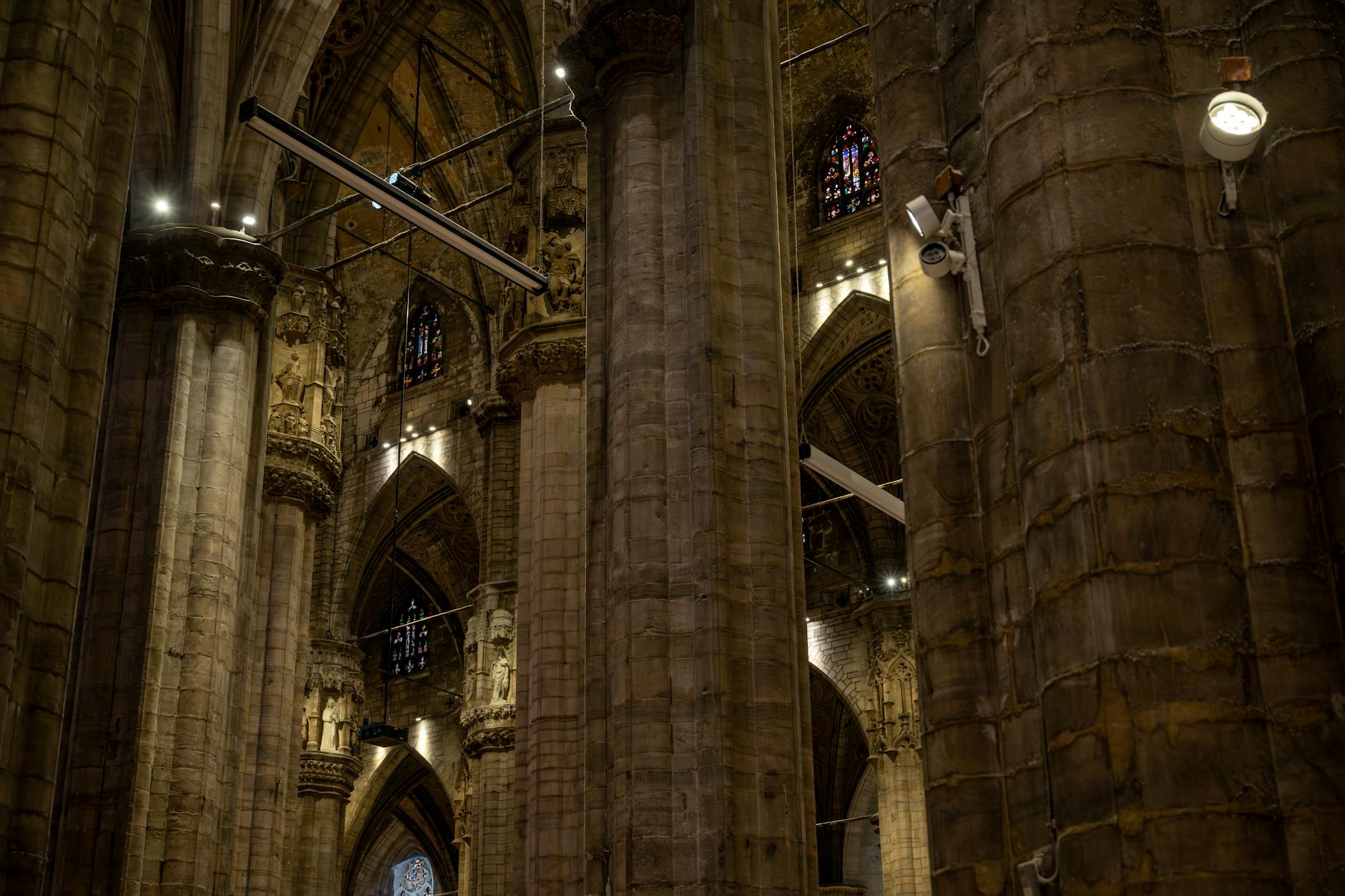
The Duomo exterior is free. The cathedral itself charges to enter, and the rooftop terraces are ticketed (rightly — that’s the best view in Milan), but the façade up close, the side flanks with their thicket of pinnacles, and the early-morning Piazza del Duomo before the pigeon-feed scammers wake up — all free. Walk around the full perimeter; the apse on the back side is the prettiest angle and almost no tourist sees it.
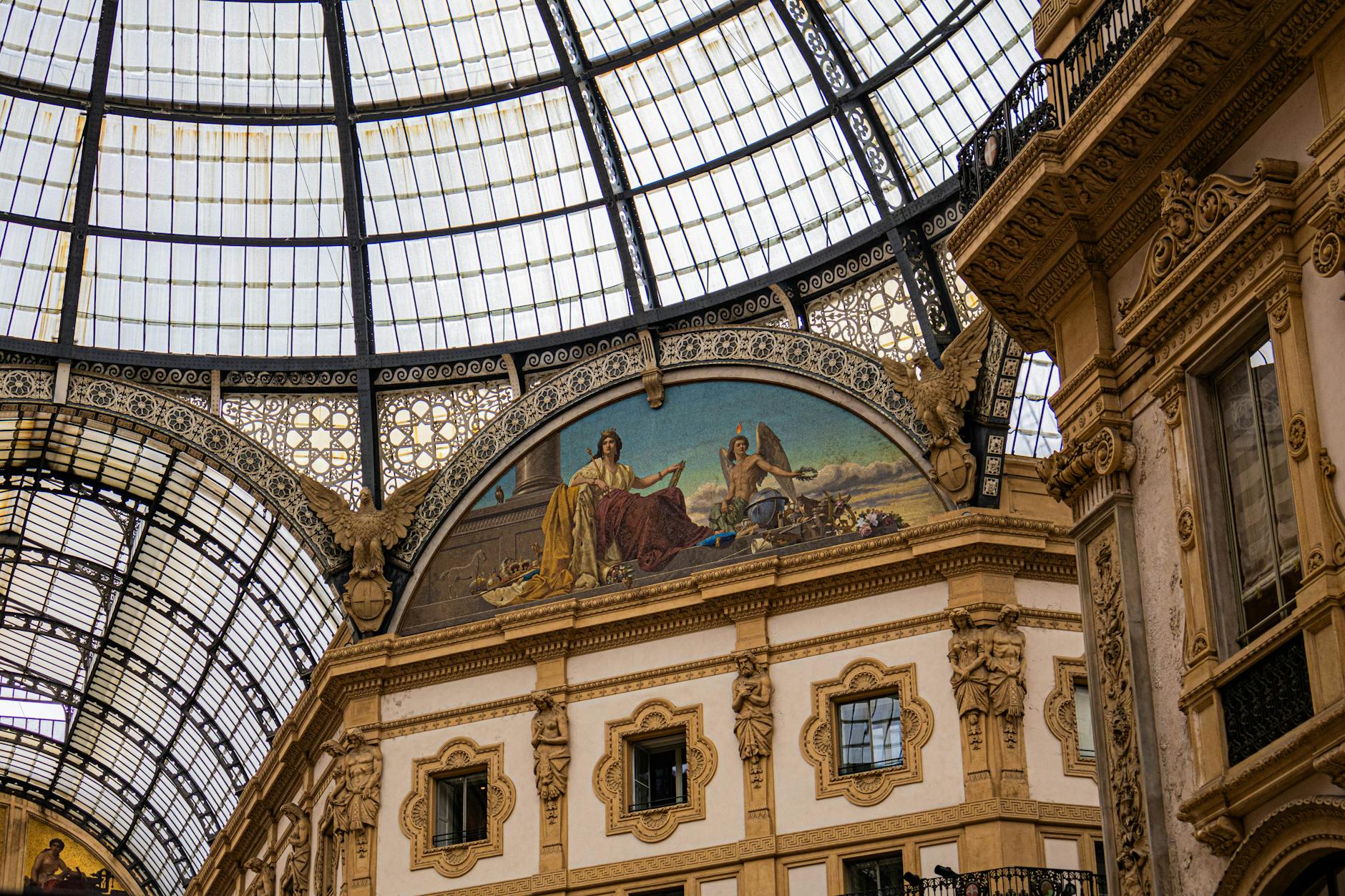
The Galleria Vittorio Emanuele II, the 19th-century glass-roofed arcade connecting Piazza del Duomo to Piazza della Scala, is a public passageway. You can walk it any hour, lit at night, and stand in the central octagon where the four continental mosaics meet. Spinning your heel on the bull’s testicles is supposed to be lucky. Free, faintly ridiculous, fully tolerated.
The Castello Sforzesco trips a lot of visitors up. The museums inside the castle cost money — the courtyards do not. The Cortile delle Armi, the Cortile della Rocchetta, and the Cortile Ducale are all free to wander, 7:00 AM to 7:30 PM in summer. You can sit on the well in the Rocchetta courtyard, the one Bramante worked on, without spending a cent. Walk through the back gate and you’re in Parco Sempione.
The Bosco Verticale in Porta Nuova — Stefano Boeri’s pair of plant-covered residential towers — is best seen for free from the wooden bridge at Piazza Gae Aulenti or the lawn of the Biblioteca degli Alberi park beneath it. You cannot enter the towers (residents only), but the public viewing is the whole point. Piazza Gae Aulenti itself, ringed by Cesar Pelli’s UniCredit Tower, is the most photographed modern square in Italy. Free fountain show, free skyline, decent free bathrooms in the shopping arcade beneath.
Free churches that are actually worth your time
This is where Milan quietly out-performs its reputation. Several of the city’s best churches charge nothing and contain artwork you’d queue an hour for in Florence.
Basilica di Sant’Ambrogio (Piazza Sant’Ambrogio 15). Free. Founded by Saint Ambrose himself in 379 AD, rebuilt in the 11th and 12th centuries into one of the great Romanesque buildings of northern Italy — two asymmetrical bell towers, a brick atrium, and the gold Paliotto altar by Vuolvinio underneath the ciborium. Open Monday to Saturday 10:00 AM to 12:00 PM and 2:30 PM to 6:00 PM, Sunday 3:00 PM to 5:00 PM. The crypt with Ambrose’s preserved remains is also free.
Chiesa di San Maurizio al Monastero Maggiore (Corso Magenta 15). Known locally as the Cappella Sistina di Milano — Milan’s Sistine Chapel — and it is not hyperbole. The entire interior, both the public nave and the Coro delle Monache behind the dividing wall, is frescoed by Bernardino Luini and his school. Around 4,000 square meters of 16th-century painting. Free. Open Tuesday to Sunday, 10:00 AM to 5:30 PM. If you visit one free interior in Milan, make it this. I’ve covered it in more depth in the Milan churches guide.
San Bernardino alle Ossa (Via Verziere 2). Tucked behind Piazza Santo Stefano, this is the bone chapel — an entire side ossuary lined floor to ceiling with the skulls and femurs of medieval Milanese. Free. Open Monday to Friday 8:00 AM to 6:00 PM, Saturday 9:30 AM to 6:00 PM, Sunday afternoons only. Not for everyone, but unforgettable and a six-minute walk from the Duomo.
Santa Maria delle Grazie (Piazza Santa Maria delle Grazie 2). The Last Supper next door is the famous part and that’s ticketed. The church itself — the Bramante apse and dome, the Solari nave, the small cloister — is free to enter. Open daily, 7:30 AM to 12:30 PM and 3:00 PM to 7:30 PM. Most Last Supper visitors race past the church without stepping inside, which is a small tragedy.
San Lorenzo Maggiore (Corso di Porta Ticinese 35). The 16 freestanding Roman Colonne di San Lorenzo outside the church are Milan’s most famous public ruins and the best free aperitivo loitering spot in the city. The church itself, with its early Christian floor plan and the 4th-century mosaics in the Cappella di Sant’Aquilino, is free; the chapel asks €2.
Parks, gardens, and outdoor breathing room
Milan’s parks are the city’s pressure valve. All are free.
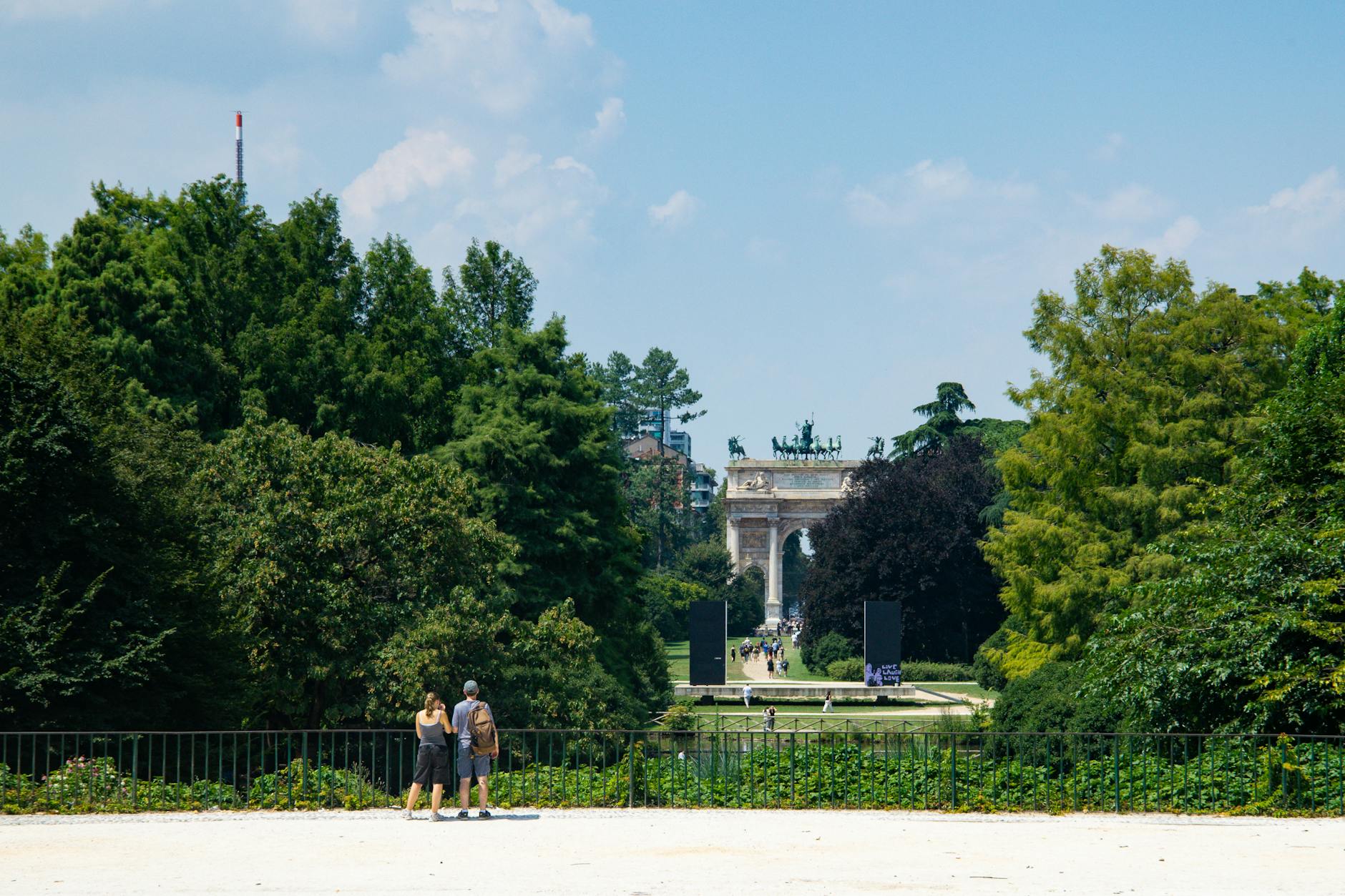
Parco Sempione (the big one, behind Sforzesco) — 95 acres designed by Emilio Alemagna in the 1890s. Daily 6:30 AM to 8:00 PM in winter, until 11:30 PM in summer. The Arco della Pace at the far end is Milan’s answer to the Arc de Triomphe. The Torre Branca observation tower inside the park costs €6 if you want the view, but the park itself doesn’t.
Giardini Pubblici Indro Montanelli (Via Palestro / Corso Venezia). Milan’s first public park, 1784, by Piermarini — the same architect as the Scala. October to April 6:30 AM to 9:00 PM, May extended to 10:00 PM, June through September open until 11:30 PM. Free playgrounds, a small free natural history museum on the grounds, and the GAM next door.
CityLife Park, in the Tre Torri district between the three Hadid, Isozaki, and Libeskind towers. Permanently open, free, and contains the ArtLine open-air sculpture trail — 22 contemporary works by Pascale Marthine Tayou, Ornaghi and Prestinari, and others scattered through the lawns. Best on a Saturday morning, when the farmers’ market sets up next to the Hadid spiral building.
Biblioteca degli Alberi (BAM) in Porta Nuova — the modern park beneath the Bosco Verticale. Free outdoor yoga classes most Saturday mornings in spring and summer (registration via the BAM website but the classes are free).
Boschetto di Rogoredo on the southeast edge of the city is wilder, less manicured, and good if you want a forest walk without leaving the metro network. Get off at Rogoredo M3 and walk south.
Hungry after a park afternoon? My cheap eats in Milan guide covers the €6 panzerotto and €4 trapizzino moves that keep a free day genuinely free.
Two self-guided walking routes that cost nothing
Tour companies charge €25 a head for what you can do yourself with this section. Both routes take about two hours at a comfortable pace.
Route 1: Brera at golden hour
Start at the Pinacoteca courtyard (Via Brera 28), pass the statue of Napoleon. Exit onto Via Fiori Chiari, the cobbled pedestrian spine with the tarot-card readers. Left onto Via Madonnina, right onto Via del Carmine to see Santa Maria del Carmine’s terracotta façade (free interior, often empty). Down Via Mercato, cross Foro Buonaparte, and you’re at Sforzesco’s eastern gate. Walk straight through the courtyards into Parco Sempione, aiming for the Arco della Pace at sunset. End with a €4 spritz at Bar Magenta on Via Carducci.
Route 2: Navigli into the Roman bones of Milan
Start at Porta Genova M2. Walk down Ripa di Porta Ticinese along the Naviglio Grande, the canal Leonardo helped engineer. Cross to Alzaia Naviglio Grande and walk back along the opposite bank — better light in the afternoon. At Darsena (the old port basin, fully reopened to the public, free to walk) turn onto Corso di Porta Ticinese. Stop at the Colonne di San Lorenzo. Continue through Porta Ticinese gate to Sant’Eustorgio (free; the Portinari Chapel inside is ticketed). End at the Basilica di Sant’Ambrogio, a 12-minute walk further. Five churches, two Roman ruins, one canal, zero euros.
For a more comprehensive set of itineraries including the paid headliners, see my Milan attractions guide.
Free Milan events worth timing a trip around
Several large city events open major parts of Milan at no cost. If you can flex your dates, build around one of these.
- Fuorisalone — the design week running parallel to the Salone del Mobile in April. The Salone itself at Rho Fiera is a trade-ticket event, but Fuorisalone scatters hundreds of free design installations across Brera, Tortona, 5VIE, Isola, and Porta Venezia. Showrooms, courtyards normally closed to the public, palazzi opened for the week. April 13 to 19 in 2026.
- Piano City Milano — May 15 to 17, 2026. Over 250 free piano concerts in courtyards, museums, train stations, rooftops, and private apartments. No tickets, just turn up. The main stage runs all weekend in the GAM gardens.
- BookCity Milano — mid-November. A week of free book talks, author meetings, and readings in 200+ venues, including a lot of normally inaccessible historic palazzi.
- Festa di Sant’Ambrogio and the Oh Bej Oh Bej market — December 7 to 10, free street market and processions around Sant’Ambrogio, the city’s patron-saint festival.
- Estate Sforzesca — summer concerts and outdoor cinema in the Sforzesco courtyards from late June through August. Many evenings free, some ticketed; the program drops in May.
University courtyards and cloisters most visitors miss
Milan has several free public-access historic interiors hiding behind university doors.
The Università degli Studi di Milano on Via Festa del Perdono 7 occupies the Ca’ Granda, the old 15th-century hospital designed by Filarete. The five inner courtyards — including the Cortile d’Onore with its Richini double loggia — are open to the public during academic hours, typically 8:00 AM to 7:00 PM weekdays. Walk straight through the main entrance, nobody stops you. The most beautiful free historic interior in the city center.
The cloisters of Sant’Ambrogio — the so-called Chiostri Bramanteschi, designed by Bramante and now part of the Università Cattolica next door to the basilica — are accessible free during weekday daylight hours through the Cattolica entrance on Largo Gemelli 1.
The Cortile delle Magnolie of the Conservatorio Verdi (Via Conservatorio 12), occasionally open during student concert days, is another small free find worth checking the calendar for.
Practical tips that save the day
- Always book Brera and the Last Supper for Domenica al Museo. Brera opens free-Sunday reservations roughly 30 days out. Last Supper drops free-Sunday slots about 60 days out and they go in under an hour. Set a phone alarm.
- Under-18s enter all state museums for free, every day, no Sunday-only restriction. EU citizens aged 18 to 25 pay a reduced €2 at state museums (Brera, Last Supper, Cenacolo). Bring ID — passport or national ID card. A driving license is not accepted.
- Civic museums (run by the Comune) — Museo del Novecento, GAM, Sforzesco — are free for everyone after 2:00 PM on the first and third Tuesday of the month. This is one of the city’s best-kept free-entry secrets and the museums are far emptier than on Sunday.
- Persons with disabilities and one accompanying person enter all Milan civic museums and libraries free, any day.
- The Acquario Civico requires booking a free timed entry through the museicivicimilano vivaticket portal, even though the ticket costs €0. Saturdays sell out by Friday afternoon.
- Bring a refillable water bottle. Milan has 600+ free public drinking fountains (the green vedovelle dragons). The water is the same as what you drink in restaurants.
For the deeper roundup of no-cost activities including nightlife and seasonal events, see the free things to do in Milan overview.
Frequently asked questions
What’s free to see in Milan?
The list is longer than most travelers expect: roughly a dozen civic museums (GAM, Boschi Di Stefano, Acquario Civico, Museo del Risorgimento, Palazzo Morando, MUDEC permanent collection, Pirelli HangarBicocca, Casa della Memoria, Museo Studio Messina), every major church interior except the Duomo and Last Supper, all city parks, the Castello Sforzesco courtyards, the Galleria Vittorio Emanuele, the Cimitero Monumentale, the Colonne di San Lorenzo, and on the first Sunday of every month the entire state museum network including Brera and the Last Supper.
Is the Duomo free?
The exterior is free and walkable any time. Entry to the cathedral interior, the archaeological area beneath, the Duomo Museum, and the rooftop terraces all require a ticket — currently €10 for the church alone, around €17 to €25 for combined tickets that include the roof. The Galleria Vittorio Emanuele right next door is fully free to walk through.
When are museums free in Milan?
The first Sunday of every month is the big one — Domenica al Museo — when all state museums including Brera and the Last Supper are free with reservation. Civic museums add a second free window: every first and third Tuesday from 2:00 PM. Several museums (GAM, Acquario Civico, Pirelli HangarBicocca, Boschi Di Stefano) are free every day they’re open.
Is Pinacoteca di Brera ever free?
Yes — free on the first Sunday of every month via Domenica al Museo, free every day for under-18s and EU citizens under 25 (€2 reduced for the latter), and free on a handful of national culture days the Ministry announces each year. Reservation through brerabooking.org is mandatory on free Sundays and strongly recommended otherwise.
Are there free things to do in Milan at night?
Plenty. The Galleria Vittorio Emanuele is illuminated until late and free to walk. Piazza Gae Aulenti and the Bosco Verticale lit up are best after dark. The Navigli canal banks are free to wander and full of live music spilling out of bars. In summer, Estate Sforzesca offers free evenings in the castle courtyards. Piano City in May runs many concerts after 9:00 PM, including a famous dawn concert at the Maspes-Vigorelli velodrome. Most parks close around 11:30 PM in summer; before that, Parco Sempione is a free outdoor living room.
Do I need to book free museum entries in advance?
Yes for some, no for others. Brera and the Last Supper require online reservations on Domenica al Museo days. The Acquario Civico requires a free timed-entry booking any day. GAM, Boschi Di Stefano, Museo del Risorgimento, Palazzo Morando, Museo Studio Messina, and Casa della Memoria all accept walk-ins.
Final thoughts
If you organize a four-day Milan trip around the first-Sunday free window, layer in the civic museums on a Tuesday afternoon, hit San Maurizio and Sant’Ambrogio on the in-between days, and use the parks and Sforzesco courtyards as your between-things filler, you can do a full cultural week here for the cost of food, transit, and one or two paid headliners like the Duomo rooftop. That’s a different kind of Milan trip than the one most people end up writing about — quieter, more local-shaped, and far more honest about what the city actually is. Use this as your spine and add the paid stuff sparingly. The free Milan is the better Milan more often than not.